
Understanding Your Jewellery Size
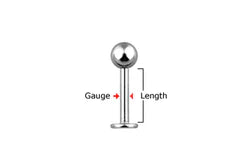
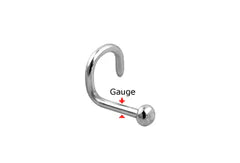
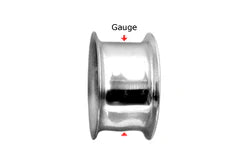
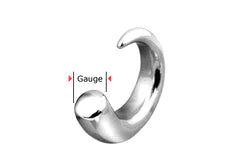
Gauge:
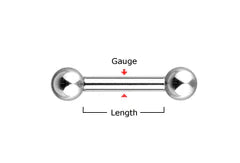
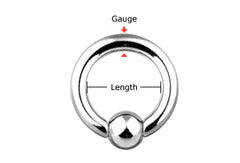
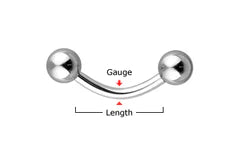
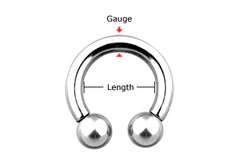
This is the thickness of the bar where the jewellery sits inside your piercing.
Length:
Measured as the distance between the ends or sides of the jewellery — not including the ends or the ring sides themselves.
👇 Scroll down to see helpful diagrams showing where to measure these on common jewellery styles.
| Gauge to mm conversion | Common Piercing |
|---|---|
| 20G is 0.8mm | Nose rings and bars |
| 18G is 1.0mm | Nose rings and bars, standard ear lobe. |
| 16G is 1.2mm | Septum rings, Lip bars and rings, Eyebrow bars and rings, Daith, Helix, Conch, Rook and other cartilage bars and rings |
| 14G is 1.6mm | Belly bars, nipple bars and rings, tongue bars, Female genital bars and rings |
Large Gauge Sizes
| Gauge (G) | Thickness (mm) |
|---|---|
| 12G | 2.0 mm |
| 10G | 2.4 mm |
| 8G | 3.2 mm |
| 6G | 4.0 mm |
| 4G | 5.0 mm |
| 2G | 6.0 mm |
| 0G | 8.0 mm |
| 00G | 10.0 mm |
Please note:
These suggested piercings sizes are a general guide. Every body is unique, and your piercer may recommend different sizes based on your anatomy and piercing location. Always consult with your piercer if you’re unsure about what size you need.
👇 Scroll down to see helpful images showing where to measure gauge and length on common jewellery styles.